
The Disdyakis Triacontahedron (D120) and the Disdyakis Dodecahedron (D48) are not "sacred geometry" in the crystal-shop sense. They're something way more interesting: they are what you get when you take a highly symmetric polyhedral system and drive it to a kind of structural completion without breaking convexity.
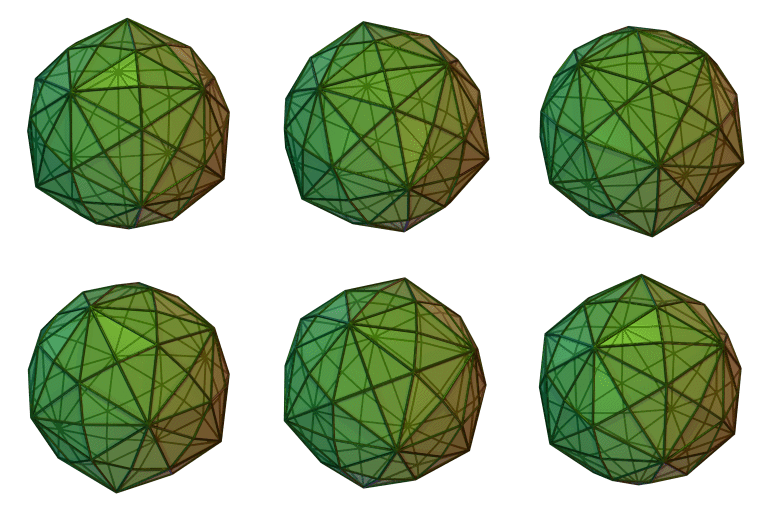
In layman's terms, most famous solids are either simple enough to be instantly legible (cube, dodecahedron), or complex in a decorative way (stellations, subdivisions, spiky ornaments). These two are different. They feel intense because they are the opposite of decorative. They are the result of symmetry being fully cashed out into explicit geometry: no implied relationships, no hidden slack, no "you can kinda see what it means." Everything that can be made explicit has been made explicit.
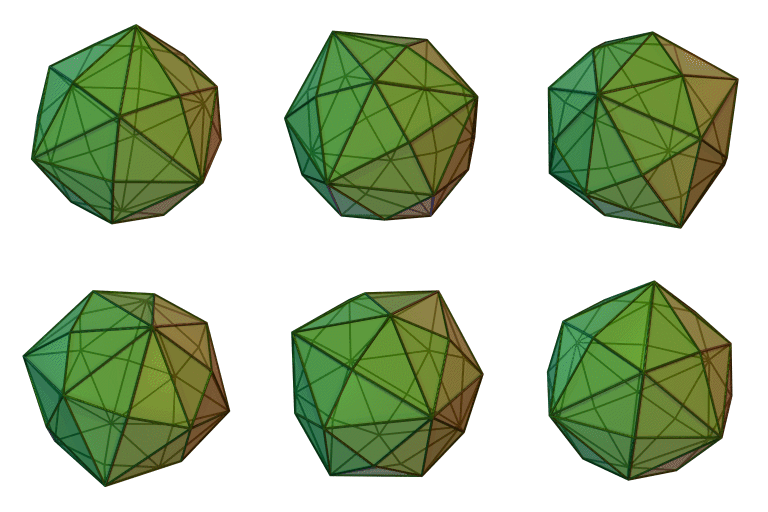
Both are Catalan solids (faces are congruent and the symmetry is global), and both are duals of truncated Archimedean solids. That matters because truncation forces latent structure out into the open (vertices turn into faces, face-types multiply), and then duality flips the whole system inside out (faces become vertices and vice versa) while preserving the adjacency logic. Add triangulation and you're left with a shape that refuses simplification. Triangles don't let you hide complexity. Every face is an irreducible statement.
So if a Platonic solid is the clean slogan of a symmetry group, a disdyakis solid is the full, itemized receipt. It's the whole schabang, the entire ball of wax. They sit near the edge of what these classical operations can express while staying finite, convex, and perfectly symmetrical. That's why they look like they're "too much" but still not chaotic. These clusterfucks are wildly compelling (and coherent!) in a way that is not magic nor mystical, but just so supremely exhaustive that it physically cannot be out-clusterfucked in any valid capacity.
| Property | Disdyakis Triacontahedron (D120) | Disdyakis Dodecahedron (D48) |
|---|---|---|
| Faces | 120 scalene triangles | 48 scalene triangles |
| Symmetry | Icosahedral (Ih) | Octahedral (Oh) |
| Vertex Types | 10, 6, 4-valence | 8, 6, 4-valence |
Neither of these beasts were known to the ancients. They showed up in the 19th century via Eugène Catalan, who was out here casually naming duals like a wizard. Meanwhile, crystal researchers discovered D48's geometry around the same time-- totally independently. So yeah, the universe was clearly in sync on this one.
The D120's 62 vertices coincide with the combined vertex positions of an icosahedron (12), a dodecahedron (20), and an icosidodecahedron (30) not because of numerology, but because truncation and dualization force multiple symmetry orbits to coexist in a single object. What looks like a stacking of Platonic and Archimedean forms is actually the geometric residue of symmetry being fully expressed and reconciled. These vertex sets don't necessarily symbolize anything extra nor do they intrinsically encode some kind of pop-spiritual woo-frue, rather they are the unavoidable outcome of driving an icosahedral system toward closure to the farthest extent possible.
These shapes aren't special because they're "consciously/spiritually charged." They're special because they're closed under the ruleset: apply the standard symmetry-preserving operations hard enough, and you land on a form where the system has spent its remaining degrees of freedom. So what we're actually looking at here is complete constraint-space saturation made visible.
Disdyakis polyhedra are frequently labeled "sacred geometry," but that label usually collapses under inspection. Most symbolic interpretations never engage with what these shapes actually do. Instead, they rely on aesthetic authority: the shape looks complex, old, and mathematical, so it gets drafted into service as proof for vague metaphysical claims.
This approach treats geometry like a talisman rather than a structure. Words like "energy," "vibration," or "higher dimensions" are invoked without reference to faces, edges, valence, symmetry groups, or transformation history. The shape becomes a visual placeholder for credibility, not an object of analysis.
The problem is not that these interpretations are insufficiently mystical. It's that they are insufficiently precise. They mistake coincidence for causation and complexity for transcendence, while ignoring the operational facts that make these solids interesting in the first place.
A more defensible notion of meaning emerges when symbolism is grounded in structure rather than projection. Disdyakis polyhedra are meaningful not because they point beyond geometry, but because they demonstrate what happens when a finite, rule-governed system is driven toward internal completion.
Through truncation, dualization, and triangulation, these shapes force all symmetry-permitted relationships into explicit form. Nothing remains latent. Nothing remains implied. What results is a convex object in which the entire constraint lattice of the symmetry group is simultaneously active and irreducible.
If there is a "gnostic" lesson here, it is not hidden knowledge or cosmic correspondence. It is this: finite systems can exhaust their own possibilities without invoking infinity, recursion, or metaphysical escape hatches. These shapes are not symbols of transcendence. They are demonstrations of closure.
This pattern of misinterpretation isn't unique to geometry. Pop-spiritual and pop-esoteric subcultures routinely appropriate language from science and higher mathematics not to understand it, but to borrow its authority. Terms like "quantum," "dimensional," "vibrational," or "topological" get stripped of operational meaning and reused as aesthetic props, creating the impression that an otherwise incoherent belief system is empirically grounded. What results is not an alternative model of reality, but a kind of credible-sounding cosplay: scientific vocabulary worn like a costume to disguise the fact that no testable mechanism is actually being described.
Disdyakis polyhedra are especially revealing in this context because they resist that kind of appropriation. Their significance is not symbolic, intuitive, or metaphor-friendly; it is mechanical. You either engage with truncation, duality, symmetry groups, and constraint limits, or you are no longer talking about the object itself. There is no room for bippity-boppified abstraction here. The geometry does not gesture toward hidden forces or cosmic truths. It demonstrates, plainly and uncomfortably, what happens when a finite ruleset is pushed to the point of exhaustion and nothing remains to be projected.
Let's be clear up front: "We" is doing a lot of work here. This section does not represent a reasonable social expectation, a public mandate, or even a small private group. It represents the temporary but intense fixation of the solitary shut-in currently running this website. Any resemblance to a universal imperative is accidental, and I'm not telling anyone how to life their life.
That said, there are real reasons these shapes deserve attention, and they have nothing to do with mysticism, destiny, or cosmic energy fields. The obsession comes from what these polyhedra demonstrate, cleanly and without theatrics, about how structured systems behave at their limits.
Disdyakis polyhedra show what happens when a symmetry-governed system is driven to closure. They make visible the point at which truncation, duality, and irreducibility have spent every remaining degree of freedom without breaking convexity or global order. There is no further refinement available that doesn't destroy the category itself. That makes them rare examples of finite systems reaching internal exhaustion honestly.
This matters because most complexity we encounter today is either decorative, recursive, or evasive. These shapes are none of those. Their complexity is earned. Every face, edge, and vertex is doing necessary work. Remove anything, and the structure collapses. Simplify anything, and information is lost. What you're looking at is not ornament, but residue.
They also provide a useful antidote to a common modern confusion: the idea that depth requires infinity, transcendence, or vagueness. Disdyakis polyhedra demonstrate the opposite. Depth can arise from finite rules applied fully, without mysticism, without metaphor, and without escape hatches. Hence why they linger in the mind. Not because they promise enlightenment, but because they refuse it. They don't gesture toward hidden truths. They show you exactly what's there, all at once, and then dare you to sit with it.
At minimum, readers are encouraged to select a stranger at random the next time they are in a public bar or pub, confidently lock them into an inescapable interaction, and explain disdyakis polyhedra until information about symmetry saturation and constraint closure flows into their being more abundantly than alcohol-- and with roughly the intensity of an unregulated firehose. Whether this results in mutual enlightenment or a justified request for personal space is outside the scope of this project.
The discussion on this page is grounded in established results from convex polyhedral theory, symmetry group analysis, and the historical study of Catalan solids.
 Browse Math Articles
 RETURN TO MAIN LIBRARY